
Special Needs Budgies
Article from “The Mickaboo Bird Rescue Companion”
Published January 2026
 By Desiree Bauer
Peggy Hartlein has been a foster parent for Mickaboo for years, caring for several budgies. She is currently fostering six budgies with special needs. Her home has become a sanctuary where these birds can recover, thrive, and socialize. This article is about some of those special needs budgies and what it takes to help them live with quality.
Peggy’s path to fostering began with her own budgies. After losing several of her personal birds, she wanted to provide companionship for her remaining bird while also helping others in need. She joined Mickaboo and began fostering, guided by the thought that any care she would give her own bird should also be available to a foster bird.
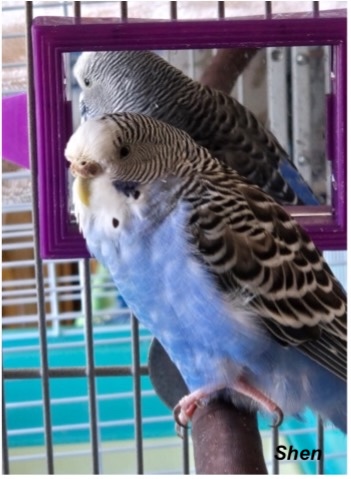 One of Peggy’s first special-needs fosters was Shen, a budgie surrendered after a dog attack left her with a broken leg. Shen stayed at the vet for initial recovery before moving into Peggy’s home. There, Peggy set up a modified cage with a raised bottom, and made sure to keep an eye on her leg. After just a couple of weeks, Shen was ready for a larger, regular set-up, and now lives in a flight cage with another budgie, Q-Tip. Other than the occasional clumsy landing and a missing toe, Shen has largely recovered from her injury under Peggy’s care.
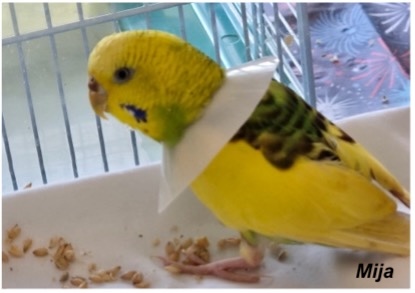
Another special bird is Mija, who came to Peggy after several vet stays. Mija struggles with feather growth around her cloaca. This situation can cause bleeding as new feathers come in. She lives in a modified tank without grates, wears a protective collar, and has monthly vet visits to remove problematic feathers. Though Mija requires careful monitoring, she’s found a budgie friend in a neighboring cage.
That friend is Hopeful, a young budgie born without legs who was surrendered to Mickaboo as a baby. During one of Peggy’s trips to the vet with Mija, she was told about a “VERY cute” and special bird, and ended up coming home with Hopeful. Hopeful started out by scooting along the ground with her beak, but as her clipped wings grew back, she began flying confidently from one side of her cage to the other. Peggy outfitted her cage with a padded, flannel-lined cage, complete with “baby budgie bumpers” that Peggy sews herself, giving Hopeful a safe place to land. Recently, Hopeful moved into a larger cage with the same design. With Mija’s cage next to her own, the two have become buddies.
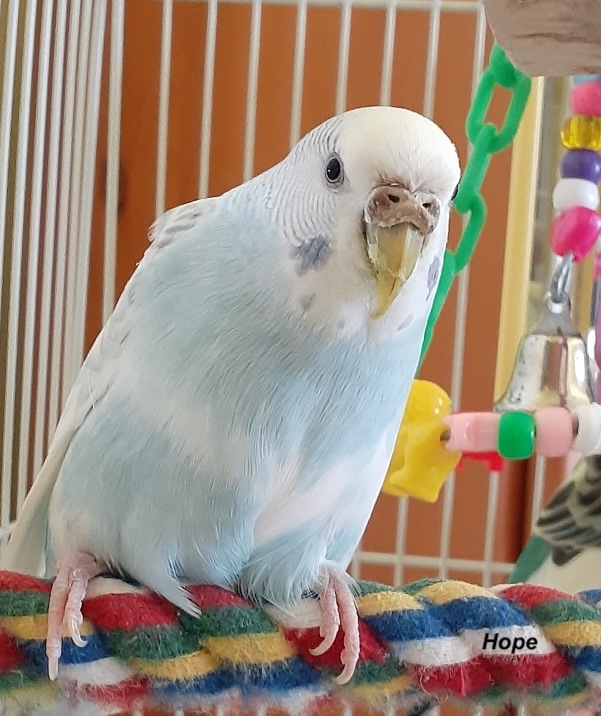 Hope is another bird who has greatly improved under Peggy’s care. She arrived grossly overweight, and with a rapidly growing beak that requires regular trimming. Peggy weighed her regularly and adjusted her diet. Hope has slimmed down significantly over time! Today, Hope is active and playful, enjoying her swing, cuttlebones, and even tossing around a plastic ball. Her beak has also improved enough that vet visits to reshape her beak have become less frequent, from every 4–6 weeks to closer to every 10 weeks.
Two of Peggy’s more recent fosters are Hanson and Rango. Hanson was reportedly attacked by another animal and had a badly broken wing. He currently lives in a raised-bottom cage for safety, but he’s doing so well that Peggy plans to transition him into a regular cage soon.
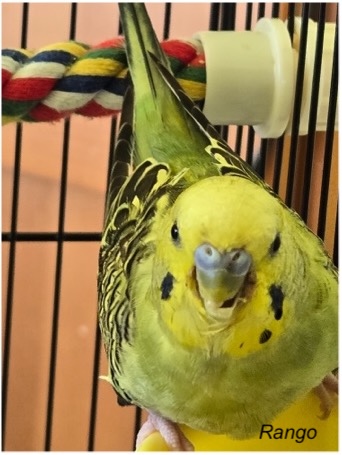 Rango, believed to be a found bird, had his own unique challenge. His upper beak was damaged, leaving him with only half. As a result, his lower beak grew unevenly and needed frequent shaping by the vet so that, with time, his beak could realign. Despite this, Rango adapted to a normal cage setup and was making progress under Peggy’s care until he died of a cardiac arrest.
Through all of these cases, Peggy’s experience shows that birds with disabilities can live full, active lives with the right environment and attention. Special-needs birds often require creativity and dedication, but caring for them provides them with a chance to recover, socialize, and enjoy life.
Peggy’s work is also a powerful reminder of the value of fostering. By providing medical care, tailored housing, and companionship, Peggy enables birds who might otherwise struggle to heal and thrive. For anyone considering adoption, her experience proves that caring for special-needs birds through their challenges can be deeply rewarding.
Back to newsletter's front page.
Copyright © 2025 Mickaboo Companion Bird Rescue
All Rights Reserved